8 Best AI-Powered Automation Platforms for Business
Publish Date
Mar 31, 2026
An AI-powered automation platform is software that combines artificial intelligence with workflow automation to run business processes with minimal human involvement. These tools integrate AI capabilities like document processing, decision-making, and natural language understanding alongside traditional RPA, API connectors, and rule-based logic.
The AI automation platforms market has matured significantly. We've built and managed automations for dozens of clients. The platforms that deliver the strongest results combine multiple technologies in a single environment.
The best tools don't just connect apps; they handle end-to-end processes across modern and legacy systems.
This guide ranks seven of the best AI automation tools based on capabilities, pricing transparency, ease of deployment, and real-world flexibility.
Key Terms
Robotic Process Automation (RPA): Software that mimics human actions on a computer screen to complete repetitive, rule-based tasks. RPA bots can click buttons, enter data, move files, and interact with applications.
AI Automation: The application of artificial intelligence to automate tasks that require judgment, pattern recognition, or unstructured data processing. AI automation goes beyond rule-based scripting.
Optical Character Recognition (OCR): Technology that converts images of text into machine-readable data. OCR is commonly used to extract information from scanned documents, invoices, and receipts.
Human-in-the-Loop (HITL): A workflow design where human workers handle steps that require judgment within an otherwise automated process. HITL ensures accuracy for tasks AI can't reliably complete alone.
iPaaS (Integration Platform as a Service): A cloud-based platform that connects software applications and automates data flows between them. iPaaS tools primarily focus on app-to-app integration.
No-Code/Low-Code: Development approaches that let users build automations through visual interfaces instead of writing traditional code. No-code requires zero programming.
Consumption-Based Pricing: A billing model where customers pay based on actual usage rather than flat subscription fees. This typically means paying per task completed or per document processed.
Wrk
Quick Summary
Wrk is a fully managed AI automation platform that combines RPA, AI, OCR, API connectors, and human-in-the-loop tasks in a single environment. It's the only platform on this list that builds, runs, and maintains automations for clients.
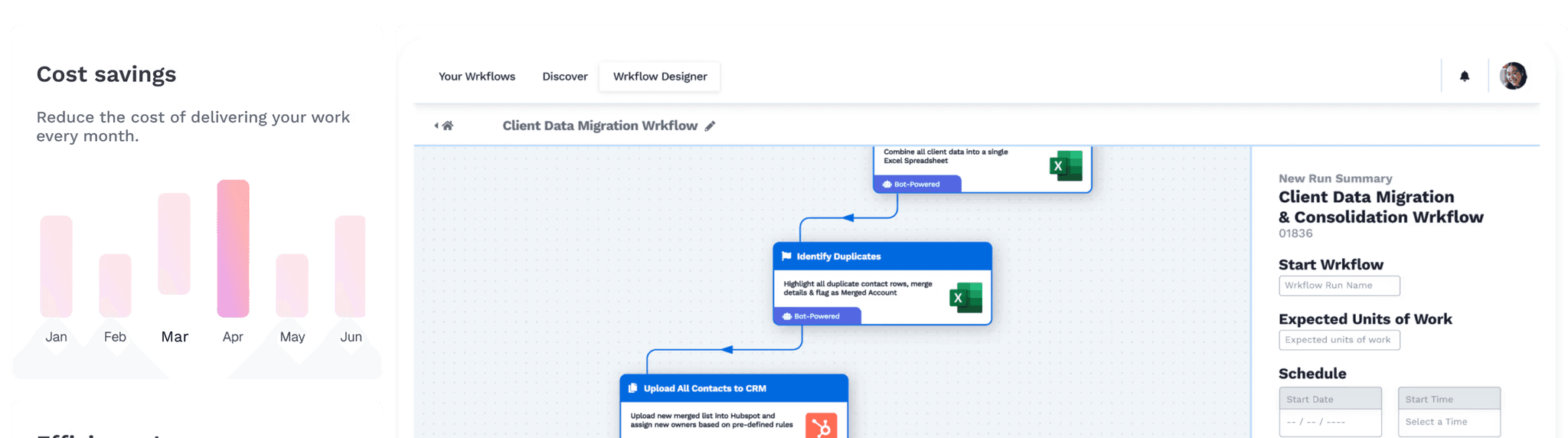
Wrk takes a fundamentally different approach to business automation. Instead of handing teams a self-service toolkit, Wrk's automation experts design, deploy, and manage the entire process. Businesses describe what they need, and Wrk delivers a working solution.
The platform orchestrates multiple automation technologies within a single workflow. A single "Wrkflow" can combine AI-powered document extraction, API connectors, desktop RPA, and human verification steps. This hybrid approach handles processes that no single automation technology can manage alone.
Wrk's vision-driven RPA stands out for legacy system support. It uses computer vision to interact with on-screen elements across web apps, desktop software, and remote sessions like RDP and Citrix environments.
Key Features
Fully managed automation service with dedicated build team and ongoing monitoring
Hybrid orchestration combining AI, RPA, OCR, API connectors, and human-in-the-loop tasks
2,500+ pre-built bots and connectors for rapid deployment
Vision-driven RPA for legacy systems, green screens, and remote desktop environments
SOC 2 Type II, HIPAA, and PIPEDA compliance
Consumption-based pricing with no per-user licensing fees
Workflow ownership: clients own their automations permanently after the build
Who Should Choose Wrk
Businesses that need end-to-end process automation but don't have in-house automation developers
Operations teams dealing with legacy systems, manual data entry, invoice processing, or CRM maintenance
Small and mid-sized companies that want enterprise-grade automation without enterprise-grade complexity
Pricing
Wrk charges a one-time build fee starting at $1,000 for custom workflow development. After the build, clients pay consumption credits starting at $250 per month. Credits are usage-based and roll over month to month.
There are no per-user licenses, no software installation requirements, and no additional module fees. If a requested automation is deemed unfeasible, Wrk fully reimburses the build cost within 30 days.
Key Insight
Wrk's managed model eliminates vendor sprawl. Instead of buying separate OCR, iPaaS, RPA, and AI licenses, Wrk bundles all capabilities in one platform. One pricing model replaces multiple vendor contracts.
UiPath
Quick Summary
UiPath is an enterprise-grade RPA platform with expanding AI agent capabilities. It's best suited for large organizations with dedicated automation teams.
UiPath is one of the most established names in robotic process automation. The platform includes a low-code workflow designer, AI Center for ML model management, and process mining tools. Orchestrator handles bot deployment, scheduling, and monitoring at scale.
In 2025, UiPath has leaned into "agentic automation." This approach combines traditional RPA bots with AI agents that handle complex, cognitive tasks. The platform integrates with major AI providers including OpenAI, Microsoft, and Google.
Key Features
Drag-and-drop Studio for building attended and unattended automations
AI Center for deploying and managing machine learning models within workflows
Process Mining and Task Mining to discover automation opportunities
Orchestrator for centralized bot management, scheduling, and monitoring
Document Understanding for intelligent document processing
Enterprise-grade governance with role-based access, audit logs, and SSO
Who Should Choose UiPath
Large enterprises with dedicated RPA development teams and complex automation portfolios
Organizations in regulated industries like banking, insurance, and healthcare
Companies already invested in the UiPath ecosystem looking to expand into AI-augmented automation
Pricing
UiPath offers three tiers: Free (for learners), Pro (starting at $420/month), and Enterprise (custom). The platform now uses a unified credit-based model called Platform Units.
Enterprise deployments typically cost six figures annually when factoring in bot licenses, AI capabilities, and infrastructure.
UiPath vs. Wrk
UiPath is a self-service platform designed for organizations with in-house automation expertise. Wrk is a managed service that handles the entire automation lifecycle. UiPath offers deeper customization but requires significant internal resources.
Wrk bundles all technologies and management into a single consumption-based fee. This makes it more accessible for teams without dedicated RPA developers.
Feature | UiPath | Wrk |
Deployment Model | Self-service with consulting | Fully managed, done-for-you |
In-House Expertise | Yes, RPA developers needed | No, Wrk builds and maintains |
AI Integration | AI Center, LLM connectors | Built-in AI, OCR, LLM integration |
Legacy System Support | Desktop and screen-based RPA | Vision-driven RPA for any screen |
Pricing Model | Per-user/bot + consumption | One-time build + consumption credits |
Entry Cost | $420/month (Pro plan) | $1,000 build + $250/month credits |
Human-in-the-Loop | Limited attended automation | Built-in HITL for edge cases |
Compliance | SOC 2, HIPAA, FedRAMP | SOC 2 Type II, HIPAA, PIPEDA |
Quick Summary
Stellar Cyber is an AI-driven security automation platform that unifies SIEM, NDR, ITDR, UEBA, and Open XDR into a single Human-Augmented Autonomous SOC. Multi-Layer AI handles detection, correlation, investigation, triage and response — with documented outcomes of up to 8x faster MTTD and 20x faster MTTR versus legacy SIEM.
Stellar Cyber is an AI-native security operations platform purpose-built for the workflows that surround threat detection and response. Where general-purpose automation tools handle finance, marketing, or customer operations, Stellar Cyber automates the SOC: turning terabytes of telemetry into a small set of investigation-ready cases analysts can act on.
The platform combines four layers of AI: detection AI to normalize and enrich raw telemetry, correlation AI (built on GraphML) to assemble multi-stage attacks into single cases, investigation AI (the AI Investigator) for natural-language threat hunting, and response AI for machine-speed containment. Every case is mapped to MITRE ATT&CK so coverage gaps surface methodically.
Stellar Cyber's Open XDR architecture integrates with hundreds of existing security tools rather than forcing a rip-and-replace, making it a fit for mid-market enterprises and MSSPs that need to modernize the SOC without abandoning existing EDR, firewall, or IAM investments.
Key Features
Multi-Layer AI spanning detection, correlation, investigation, triage and automated response
Open XDR architecture with hundreds of pre-built integrations across EDR, firewall, identity, and cloud
Unified platform combining AI-driven SIEM, NDR/OT, ITDR, UEBA, and threat intelligence under one license
AI Investigator enabling natural-language threat hunting without proprietary query languages
Agentic auto-triage for routine alert validation (phishing, credential abuse) without analyst time
MITRE ATT&CK and NIST 800-207 zero trust alignment built into detections and case management
Who Should Choose Stellar Cyber
Mid-market enterprises and MSSPs operating lean SOCs that need autonomous threat detection without enterprise-tier SIEM costs
Security teams looking to consolidate fragmented tooling (SIEM + NDR + UEBA + SOAR) into a single platform
MSSPs selling SOC-as-a-Service or MDR-as-a-Service who need multi-tier, multi-tenant architecture
Pricing
Stellar Cyber uses quote-based pricing tied to data volume and deployment scope rather than per-user licensing. The unified license covers AI-driven SIEM, NDR, ITDR, UEBA, and Open XDR with no separate module fees. Contact Stellar Cyber for a custom quote.
Stellar Cyber vs. Wrk
Stellar Cyber and Wrk automate different halves of the operations stack. Stellar Cyber automates inside the SOC: detection, correlation, investigation, and incident response, using AI built specifically for security telemetry and adversary behavior. Wrk automates the business operations that surround security: compliance evidence collection, vendor risk onboarding, audit prep, identity lifecycle workflows, and document-heavy work that doesn't belong inside an XDR.
Many regulated organizations end up running both. Stellar Cyber handles threat detection and response in the SOC console; Wrk handles the supporting operational workload so analysts stay focused on threats.
Feature | Stellar Cyber | Wrk |
|---|---|---|
Primary Use Case | Security operations (SOC) | Business process automation |
AI Focus | Multi-Layer AI for threat detection | AI bots, OCR, LLMs for business workflows |
Automation Type | Autonomous SOC, agentic threat response | RPA, OCR, AI bots, HITL |
Deployment Model | Self-service or via MSSP partner | Fully managed, done-for-you |
Best For | Detection, correlation, incident response | Compliance, identity, document, onboarding workflows |
Pricing Model | Quote-based (data volume) | One-time build + consumption |
Compliance / Alignment | MITRE ATT&CK, NIST 800-207 | SOC 2 Type II, HIPAA, PIPEDA |
Zapier
Quick Summary
Zapier is a no-code automation platform connecting over 7,000 apps through trigger-action workflows. It's best for straightforward app-to-app integrations.
Zapier is one of the most widely adopted automation tools, largely because of its simplicity. Users create "Zaps" by selecting a trigger event in one app and defining actions in other apps. The platform supports multi-step workflows, conditional paths, and AI-powered automation.
Zapier has expanded beyond basic automations. It now includes Tables, Interfaces, Chatbots, and MCP for connecting AI tools. In our testing, the AI features feel more supplementary than foundational.
Key Features
7,000+ app integrations with no-code setup
Multi-step Zaps with conditional logic, filters, and branching paths
AI Copilot for natural language workflow creation
Built-in Tables for data storage and Interfaces for simple front-ends
Chatbots for AI-powered conversational workflows
SOC 2 Type II compliance on Enterprise plans
Who Should Choose Zapier
Small teams and solo operators who need quick app-to-app connections without developer support
Marketing and sales teams automating lead routing, email sequences, and CRM updates
Non-technical users who value ease of use over depth of automation
Pricing
Zapier offers a Free plan with 100 tasks/month. The Professional plan starts at $29.99/month with 750 tasks. Team starts at $103.50/month, and Enterprise is custom.
Costs scale with task volume. Every action a Zap performs counts as one task, so multi-step workflows consume tasks quickly.
Zapier vs. Wrk
Zapier and Wrk serve different automation needs. Zapier excels at connecting cloud apps with lightweight workflows. Wrk handles end-to-end processes that span multiple systems.
Zapier can't automate desktop applications or handle processes that need human verification. Wrk covers all of those scenarios within a single managed engagement.
Feature | Zapier | Wrk |
Deployment Model | Self-service, no-code | Fully managed, done-for-you |
App Integrations | 7,000+ cloud apps | 2,500+ bots, APIs, connectors |
RPA/Desktop | Not supported | Vision-driven RPA |
Document Processing | Not native | Built-in OCR and AI extraction |
Human-in-the-Loop | Not supported | Built-in HITL |
Pricing Model | Per-task subscription tiers | One-time build + consumption |
Entry Cost | Free / $29.99/mo Pro | $1,000 build + $250/mo credits |
Legacy Systems | Cloud apps only | Legacy, desktop, and cloud |
Make (formerly Integromat)
Quick Summary
Make is a visual automation platform offering more workflow complexity than Zapier at a lower price. It's best for technical teams needing advanced branching logic.
Make uses a visual "scenario" builder that maps entire workflows on a single canvas. This approach makes it easier to manage complex automations with branching paths, loops, and error handling. Make supports over 1,200 app integrations.
Make doesn't include native AI capabilities, but it connects to external AI services like OpenAI and Anthropic through API modules. In 2025, Make shifted from an operations-based to a credit-based billing system.
The platform now supports agentic AI through its visual builder. Teams can create autonomous workflows that combine AI decision-making with automated actions.
Key Features
Visual drag-and-drop scenario builder with full workflow visualization
Advanced logic including routers, filters, iterators, and error handlers
1,200+ app integrations with custom HTTP/webhook support
Credit-based pricing that can be more cost-effective at scale
SOC 2 Type II and GDPR compliance
API and webhook modules for connecting custom systems
Who Should Choose Make
Technical marketers and operations teams needing branching and data manipulation
Small to mid-sized businesses looking for more complexity than Zapier at lower cost
Developers who want a visual builder with optional code-level customization
Pricing
Make offers a Free plan with 1,000 operations/month. Paid plans start at $9/month (Core, billed annually) and scale to $29/month Pro. Enterprise pricing is custom.
Make vs. Wrk
Make is a powerful self-service tool for teams comfortable building their own automations. Wrk removes that burden entirely. Make lacks RPA, native OCR, and human-in-the-loop support.
Wrk covers all of these in a single managed package. This makes it more suitable for complex, end-to-end business processes.
Feature | Make | Wrk |
Deployment Model | Self-service, visual builder | Fully managed, done-for-you |
RPA/Desktop | Not supported | Vision-driven RPA |
Native AI | External AI via API only | Built-in AI with LLM integration |
Document Processing | Not native | Built-in OCR and AI extraction |
Human-in-the-Loop | Not supported | Built-in HITL |
Pricing Model | Credit-based subscriptions | One-time build + consumption |
Entry Cost | Free / $9/mo Core | $1,000 build + $250/mo credits |
Pro Tip
When evaluating automation platforms, separate "app connectors" from "process automation." Connecting two cloud apps is a solved problem. The real challenge is automating end-to-end workflows that span multiple systems and handle exceptions.
Automation Anywhere
Quick Summary
Automation Anywhere is a cloud-native RPA platform with AI-powered IQ Bot for document processing. It targets mid-to-large enterprises in regulated industries.
Automation Anywhere offers its Automation 360 platform, combining RPA, AI, and process orchestration. The IQ Bot uses machine learning for intelligent document processing, handling unstructured data from invoices, contracts, and forms.
The platform provides a Bot Store with over 1,200 pre-built bots and digital workers. Automation Anywhere has been investing in agentic AI capabilities, and bots can now make decisions based on LLM integrations.
The platform supports deployment across cloud, on-premise, and hybrid environments.
Key Features
Cloud-native Automation 360 platform with web-based bot builder
IQ Bot for AI-powered document extraction and processing
Bot Store with 1,200+ pre-built bots and digital workers
Attended and unattended automation support
Process Discovery for identifying automation candidates
Enterprise security with AES-256 encryption and role-based access
Who Should Choose Automation Anywhere
Mid-to-large enterprises in financial services, healthcare, or insurance
Organizations with existing RPA programs looking for cloud-native deployment
Companies with in-house RPA developers who need a full-featured bot environment
Pricing
Automation Anywhere offers a free Community Edition. The Cloud Starter Pack begins at approximately $750/month, including one bot creator, one control room, and one unattended bot.
Additional unattended bots cost around $500/month each. Additional attended users cost approximately $125/month.
Automation Anywhere vs. Wrk
Automation Anywhere is a self-service RPA platform for enterprises with technical teams. Wrk bundles similar capabilities into a fully managed service, including RPA, AI, and document processing.
Automation Anywhere's bot-based licensing can scale costs quickly. Wrk's consumption model ties costs directly to results, making it faster to deploy for teams without RPA developers.
Feature | Automation Anywhere | Wrk |
Deployment Model | Self-service + pro services | Fully managed, done-for-you |
In-House Expertise | Yes, bot developers needed | No, Wrk builds and maintains |
AI Document Processing | IQ Bot for extraction | Built-in OCR and AI extraction |
Pre-Built Bots | 1,200+ in Bot Store | 2,500+ bots and connectors |
Human-in-the-Loop | Attended automation only | Built-in HITL with workforce |
Pricing Model | Per-bot monthly licensing | One-time build + consumption |
Entry Cost | ~$750/month | $1,000 build + $250/mo credits |
Deployment Options | Cloud, on-premise, hybrid | Cloud-based managed service |
Microsoft Power Automate
Quick Summary
Microsoft Power Automate is a workflow automation tool tightly integrated with Microsoft 365. It's the natural choice for Microsoft-centric organizations.
Microsoft Power Automate provides cloud-based workflow automation, desktop RPA, and AI Builder within the broader Power Platform. The tool connects natively with SharePoint, Teams, Outlook, and Dynamics 365.
Power Automate's Copilot lets users describe workflows in natural language and generates drafts automatically. The platform includes Process Mining for analyzing workflows and Desktop flows for Windows RPA.
Key Features
Deep native integration with Microsoft 365, Dynamics 365, and Azure
Cloud flows for app automation and desktop flows for RPA
AI Builder for form processing, object detection, and text recognition
Copilot for natural language workflow creation
Process Mining for workflow analysis and optimization
750+ pre-built connectors for cloud and on-premise systems
Who Should Choose Microsoft Power Automate
Organizations heavily invested in Microsoft 365 wanting integrated automation
IT departments looking for a platform within existing Microsoft licensing agreements
Teams needing a mix of cloud workflow automation and Windows desktop RPA
Pricing
Power Automate Premium starts at $15/user/month. The Process plan costs $150/bot/month. Hosted Process runs $215/bot/month, and AI Builder is $500/unit/month.
Qualifying Microsoft 365 subscribers get basic features at no extra cost. Premium connectors and RPA require paid plans.
Microsoft Power Automate vs. Wrk
Power Automate works best inside the Microsoft ecosystem, while Wrk is ecosystem-agnostic. Power Automate requires teams to build and maintain their own flows.
Costs can escalate with premium connectors, AI Builder credits, and extra bot licenses. Wrk's managed model includes all technologies in a single consumption-based fee.
Key Data Point
We've seen clients reduce processing times by over 95%. Wrk's case study with TrueDoor shows work order processing dropping from 2-5 days to 30 minutes.
Feature | Power Automate | Wrk |
Deployment Model | Self-service, Microsoft ecosystem | Fully managed, done-for-you |
Ecosystem Focus | Microsoft-centric | Ecosystem-agnostic |
Desktop RPA | Windows only | Vision-driven (any OS/screen) |
AI Capabilities | AI Builder (add-on), Copilot | Built-in AI, OCR, LLM |
Human-in-the-Loop | Approval flows only | Full HITL with workforce |
Pricing Model | Per-user + per-bot + add-ons | One-time build + consumption |
Entry Cost | $15/user/month | $1,000 build + $250/mo credits |
Workato
Quick Summary
Workato is an enterprise iPaaS and automation platform for large organizations with complex integration and governance requirements. It's powerful but carries a significant price tag.
Workato positions itself as an enterprise integration and automation platform. It uses "recipes" to connect applications, transform data, and orchestrate processes across cloud and on-premise systems.
The platform supports over 700 enterprise connectors with strong governance controls. These include role-based access, audit logs, and SOC 2 Type II compliance.
Workato's recent additions include agentic AI and pre-built agents for HR, sales, procurement, and customer care. The platform holds a 4.7/5 rating on G2 as of late 2025.
However, its pricing is quote-based and starts at approximately $10,000/year. That makes it one of the more expensive options on this list.
Key Features
700+ enterprise connectors with unlimited recipes on workspace plans
Recipe-based automation with conditional logic, loops, and error handling
On-Premise Agent (OPA) for connecting on-premise databases and applications
Pre-built agentic AI for HR, sales, procurement, and customer service
Enterprise governance with RBAC, audit logs, SOC 2, GDPR, HIPAA
Workbot for Slack and Teams for chat-based automation triggers
Who Should Choose Workato
Large enterprises with complex, cross-departmental integration needs
IT teams managing hundreds of app connections across cloud and on-premise
Organizations with automation budgets exceeding $50,000 annually
Pricing
Workato doesn't publish fixed pricing. Industry estimates put annual costs at $10,000 to $180,000+ depending on edition and task volume.
Task packages are purchased separately. High-Volume Recipe pricing converts per-task billing into a flat recipe fee for heavy-usage workflows.
Workato vs. Wrk
Workato targets large enterprises with complex integration needs and substantial budgets. Wrk serves a broader range of business sizes with a more accessible pricing model.
Workato offers deeper integration governance but requires teams to build their own recipes. Wrk's managed approach delivers results without internal development resources.
Feature | Workato | Wrk |
Deployment Model | Self-service enterprise | Fully managed, done-for-you |
Target Market | Large enterprises | SMBs to mid-market |
Integration Connectors | 700+ enterprise connectors | 2,500+ bots and connectors |
RPA Capabilities | Limited (API-focused) | Vision-driven RPA |
AI Capabilities | Agentic AI, pre-built agents | Built-in AI, OCR, LLM |
Human-in-the-Loop | Not a core feature | Built-in HITL with workforce |
Pricing Model | Quote-based + task packages | One-time build + consumption |
Entry Cost | ~$10,000+/year | $1,000 build + $250/mo credits |
Full Comparison: All 8 AI Automation Platforms
Platform | Best For | AI | RPA | Managed | Entry Price | Model |
|---|---|---|---|---|---|---|
Wrk | Managed automation | Built-in AI, OCR, LLMs | Vision-driven | Yes | $1K + $250/mo | Consumption |
UiPath | Enterprise RPA | AI Center, agents | Desktop + screen | No | $420/mo Pro | Per-user + credits |
Stellar Cyber | Security operations (SOC) | Multi-Layer AI for threat detection | Limited (security-focused) | No | Quote-based | Data-volume based |
Zapier | App-to-app | AI Copilot | None | No | Free / $30/mo | Per-task tiers |
Make | Visual workflows | External AI via API | None | No | Free / $9/mo | Credit-based |
AA | Enterprise docs | IQ Bot, agentic AI | Attended + unattended | No | ~$750/mo | Per-bot |
Power Automate | Microsoft orgs | AI Builder, Copilot | Desktop (Windows) | No | $15/user/mo | Per-user + add-ons |
Workato | Enterprise iPaaS | Agentic AI, agents | Limited | No | ~$10K+/yr | Quote-based |
Start Here: AI Automation Checklist
Getting started with AI automation doesn’t require a six-figure budget or an internal development team. These five steps will help any organization move from evaluation to execution.
Audit high-volume manual processes. Identify three to five workflows that consume the most staff hours, especially data entry and document processing.
Define success metrics before selecting a platform. Decide whether the goal is cost reduction, faster processing, or error elimination.
Assess internal technical resources honestly. If the team doesn’t include RPA developers, prioritize managed platforms over self-service tools.
Request a pilot or proof of concept. Test the platform against a real workflow. Wrk offers a feasibility guarantee with a full refund if the automation isn’t viable.
Calculate total cost of ownership, not just license fees. Factor in implementation time, developer salaries, maintenance, and add-on fees.
Frequently Asked Questions
What is an AI-powered automation platform?
An AI-powered automation platform is software that combines artificial intelligence with workflow automation to execute business processes with minimal human involvement. These platforms integrate AI capabilities like NLP, OCR, and machine learning with traditional tools such as RPA bots and API connectors.
How much do AI automation platforms cost?
Pricing varies widely. Entry-level tools like Make start at $9/month, while enterprise platforms like Workato can exceed $80,000 annually.
Wrk offers a one-time build fee starting at $1,000 with usage-based credits from $250/month. Power Automate starts at $15/user/month, and Zapier begins at $29.99/month.
What's the difference between RPA and AI automation?
RPA follows rigid, rule-based scripts to perform repetitive tasks. AI automation adds intelligence through capabilities like document understanding and decision-making. Most modern platforms combine both approaches.
Do businesses need developers to use AI automation tools?
Not necessarily. Many platforms offer no-code or low-code interfaces for non-technical users. Platforms like Wrk go further with fully managed services.
Enterprise platforms like UiPath and Automation Anywhere often require developer involvement for complex use cases.
Which AI automation platform is best for small businesses?
Wrk is a strong fit because its managed model eliminates the need to hire automation specialists. Consumption-based pricing means companies only pay for results. Zapier and Make are also popular for simpler, self-service automations.
Can AI automation platforms integrate with legacy systems?
Yes, several platforms support legacy integration. Wrk uses vision-driven RPA that interacts with on-screen elements without requiring API access.
UiPath and Automation Anywhere also offer screen-based automation. Cloud-first platforms like Zapier and Make are more limited in legacy support.
What industries benefit most from AI-powered automation?
Finance, healthcare, retail, and manufacturing see the highest returns. Finance teams use it for invoice processing and compliance, while healthcare automates patient intake and claims.
Retailers automate inventory and order fulfillment. Manufacturing companies apply it to supply chain and quality control.